No.01
Query-First Foundation
Triveni starts from the read path, not just ingestion, so fresh telemetry is shaped for fast querying from the beginning.
Triveni is an educational system study that turns fresh device telemetry into typed batches, durable table snapshots, hot cached reads, and a stable query surface for dashboards, APIs, and analytical workflows.
Prototype Notice
This is a prototype built for educational purposes after studying GHz Architecture. It highlights the concepts and system ideas, but a lot more engineering work would still be required before treating it as production-ready.
System Promise
Ingest Once. Query Many.
Instead of treating analytics as a downstream cleanup job, Triveni shapes telemetry for repeated reads from the beginning.
Prototype Status
Built To Explain, Not To Ship
The implementation is meant to communicate the architecture clearly. It is intentionally framed as a study prototype, not as a finished production system.
Query-First Pipeline Diagram
Devices to SQL over Arrow, Parquet, Delta snapshots, and hybrid cache
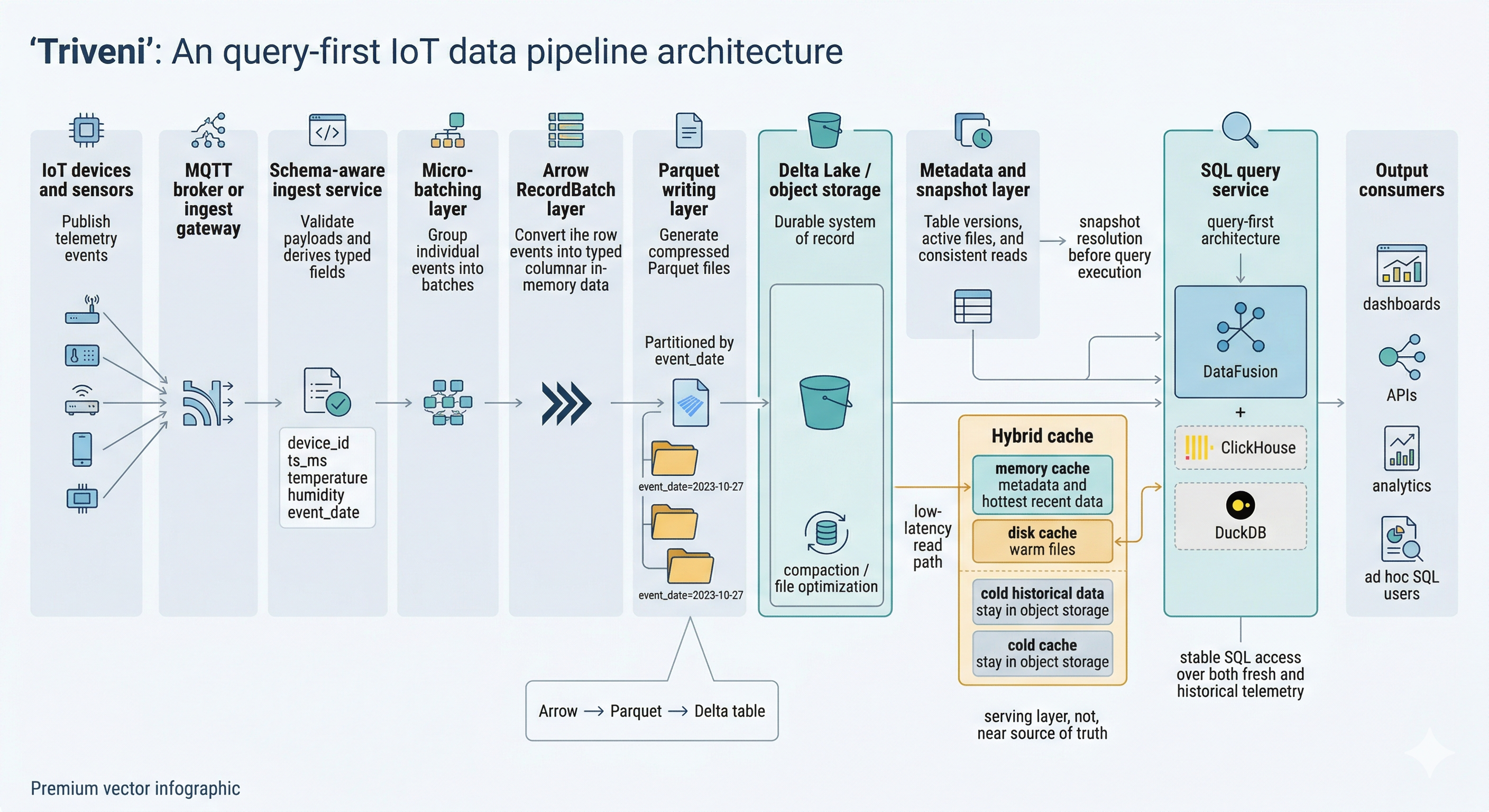
Triveni starts from the read path, not just ingestion, so fresh telemetry is shaped for fast querying from the beginning.
This part explains why Arrow and Parquet fit repeated analytical reads better than keeping telemetry as row-shaped messages.
This section shows why durable analytics needs table snapshots, transaction-aware storage, and control over file economics.
Triveni keeps metadata and frequently reused data close so object storage stays durable truth without making every read cold.
The final part focuses on the query surface, engine choices, and how Triveni serves dashboards, APIs, and analytical access.
Why immediate queryability changes the whole backend shape and pushes design effort into the read path early.
How JSON, Protobuf, Arrow, and Parquet affect CPU cost, data shape, and the efficiency of repeated scans.
Why raw files are not enough, how table metadata defines truth, and where batching and compaction matter.
How memory, disk, and object storage work together to keep the hot working set fast without breaking correctness.
How Triveni exposes one query surface while keeping the execution layer flexible for different serving models.
Telemetry arrives from devices as raw events, but Triveni treats the next important operation as querying, not only delivery.
Incoming events are validated and grouped by a known schema so the pipeline can build typed batches early.
The pipeline converts event fields into typed columns so later scans avoid repeated row-by-row reconstruction work.
Batches are persisted as columnar files and published through snapshot-aware table metadata for durable, consistent reads.
Readers do not guess from directory listings; they resolve the latest valid snapshot and scan only active files.
Memory protects critical metadata, disk keeps warm files nearby, and object storage remains the durable source of truth.
Triveni exposes one query-facing contract so dashboards, APIs, and analysis tools can access fresh telemetry consistently.
End users consume the data through product interfaces, not by managing the pipeline internals or storage mechanics.
This prototype starts from the read path. The goal is to explain why queryability changes ingest, storage, and table design from the beginning.
Triveni is intentionally framed as a study project. It demonstrates concepts clearly, while leaving the heavier production engineering work explicit and unfinished.
The system ideas here were shaped after studying GHz Architecture. This project adapts those patterns into a learning-oriented walkthrough for telemetry systems.
Operational hardening, deeper testing, production safety, and runtime validation still need substantial engineering before this should be treated as a real deployable system.